
A New Window Into South Indian Film Culture
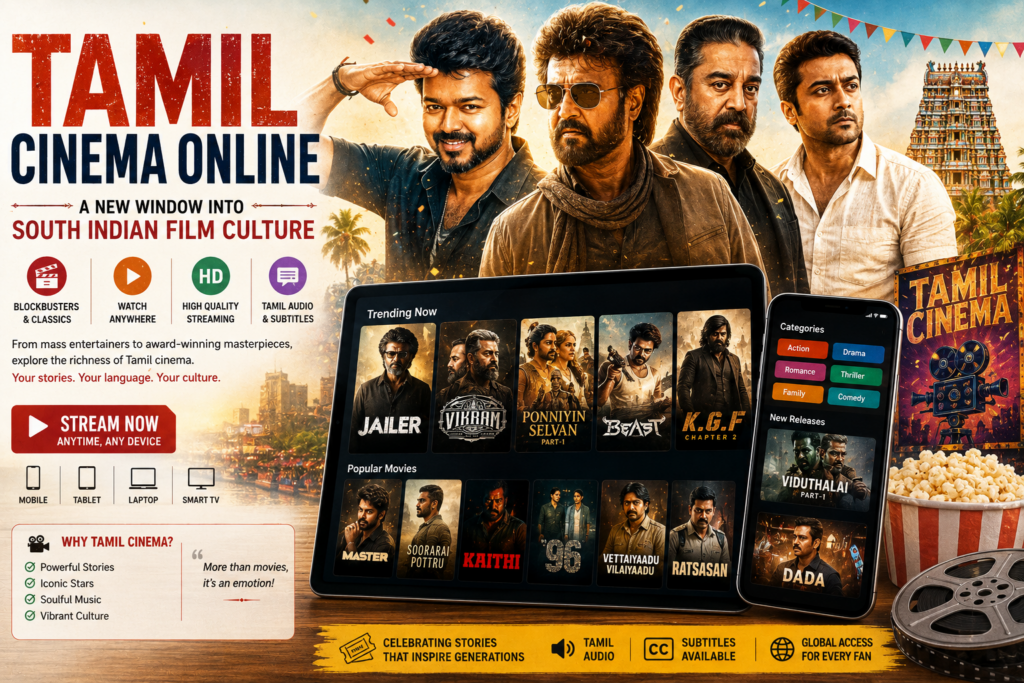
Tamil cinema has developed into one of India’s most distinctive regional film industries, with a cultural reach extending from Tamil Nadu to a substantial international audience. Its catalog encompasses commercial entertainment, independent filmmaking, family-oriented cinema, action, comedy, romance, crime, suspense, historical subjects, and many other forms. The growth of digital distribution has made this diversity easier to explore beyond the traditional boundaries of theaters and television. For audiences interested in তামিল মুভি অনলাইন, online access creates a convenient way to discover Tamil-language cinema according to personal interests and schedules.
The Scale Behind Tamil Cinema
Tamil filmmaking is often described simply as a regional branch of Indian cinema, but its history and audience make it a significant cinematic culture in its own right. The industry centered around Tamil Nadu has developed distinctive production traditions, stars, genres, music cultures, and audience expectations over many decades.
Its influence also extends beyond the state itself. Tamil-speaking communities across Sri Lanka, Singapore, Malaysia, the Gulf region, Europe, North America, and other parts of the world have helped create an international audience for Tamil-language entertainment.
Digital distribution has strengthened this geographic reach. A viewer no longer needs to live near a Tamil-language theater or television market to discover the latest and established parts of the catalog. An online environment can provide access through a single digital interface, making Tamil cinema easier to explore from different regions.
More Than One Tamil Movie Style
Tamil cinema cannot be reduced to a single recognizable formula. The broader industry encompasses commercial action, family entertainment, romantic cinema, comedy, crime, mystery, psychological drama, historical subjects, social themes, fantasy, and experimental filmmaking.
This variety gives viewers more freedom when browsing online. Someone may want a fast-paced genre one evening and something quieter on another occasion. A digital catalog can accommodate these changes by separating content into useful categories rather than presenting every title as part of one undifferentiated collection.
The diversity also encourages discovery. Viewers who are already familiar with Tamil cinema can explore less familiar genres, while newcomers can begin with categories that feel recognizable. An effective catalog does not simply display a large number of movies; it helps audiences understand how those movies relate to one another.
This is where intuitive navigation becomes particularly important. Genre shelves, curated collections, search tools, and filters can transform a large Tamil movie archive into an environment that feels manageable and inviting.
Language, Music and Tamil Cultural Identity
Language is at the heart of Tamil cinema, but its cultural identity extends well beyond dialogue. Music, regional landscapes, social traditions, fashion, architecture, humor, and changing urban life all contribute to the character of Tamil filmmaking.
Music has a particularly strong relationship with the Tamil film industry. Film songs have long existed as part of a wider popular culture, often reaching listeners independently of the movies in which they appear. Contemporary digital production has expanded the possibilities for sound design and musical presentation while maintaining this close relationship between cinema and music.
Visual identity has evolved alongside technology. Modern Tamil productions can combine sophisticated cinematography, digital effects, contemporary production design, and large-scale action with cultural references rooted in the region.
For international audiences, these elements make Tamil cinema an opportunity to experience a distinctive part of South Indian culture through entertainment rather than through abstract cultural information.
Tamil Cinema Beyond Tamil Nadu
Tamil-language filmmaking has always had an audience outside its primary domestic market. The global Tamil diaspora has created demand for Tamil entertainment in many countries, while international interest in Indian regional cinema has grown as digital distribution has expanded.
For viewers abroad, online access can be especially valuable. Local television channels may offer only limited Tamil programming, and theatrical releases can vary significantly by market. A digital catalog removes some of those geographical limitations by making Tamil-language entertainment accessible through an internet-connected device.
This international availability also introduces Tamil cinema to audiences who may not speak Tamil fluently. Subtitles and multilingual interfaces can help reduce language barriers, allowing viewers to explore regional filmmaking while retaining its original cultural context.
The result is a more direct relationship between Tamil filmmakers and international audiences. Cinema can travel across borders without depending entirely on physical distribution or local programming decisions.
The Digital Shift in Tamil Movie Discovery
The way audiences discover Tamil cinema has changed significantly with the growth of online entertainment. Traditional television schedules and theatrical advertising once played a major role in determining which movies became visible to viewers. Digital catalogs introduce additional discovery paths through categories, search, curated shelves, and recommendations.
This is particularly useful for a large regional industry. A viewer who knows exactly what they want can use search or genre filters, while someone browsing casually can move through different shelves and discover unfamiliar titles.
The distinction between discovery and viewing also becomes smaller. Instead of finding information about a movie somewhere else and then searching for a way to watch it, audiences can often move directly from a catalog shelf into playback.
Moviewala’s frictionless approach is designed around this simple transition. Viewers can explore the available Tamil selection, choose a title directly from the shelf, and move toward playback without a mandatory registration wall. The absence of annoying pop-ups keeps the interface focused on the catalog rather than interrupting the discovery process.
Why Direct Access Matters
The number of clicks required before a movie begins can have a surprisingly strong effect on the overall viewing experience. When a platform introduces repeated registration requests, unnecessary redirects, or intrusive promotional windows, the catalog itself becomes harder to enjoy.
A more streamlined environment reduces this distance. One-click access allows viewers to move from a content shelf toward playback with minimal effort. This is especially useful when browsing several Tamil movies because audiences can compare different genres and titles without repeatedly starting over.
The absence of a sign-up wall also changes how the platform feels at the beginning of a session. Viewers can first explore the catalog and decide what interests them rather than being required to establish an account before understanding what is available.
For regional cinema, this simplicity has another advantage: it lowers the barrier for international viewers who may be discovering Tamil entertainment for the first time.
Watching Tamil Movies on Different Screens
Online Tamil cinema is increasingly independent of any particular device. Smart TVs provide a natural setting for home viewing, while laptops and desktops offer flexibility for individual sessions. Tablets and smartphones allow audiences to access the same entertainment when they are away from a larger screen.
This flexibility is particularly important for international Tamil-speaking communities, whose viewing habits may differ significantly from those of audiences in Tamil Nadu. A viewer can choose a screen based on personal circumstances rather than the limitations of local television infrastructure.
A modern interface needs to accommodate these differences without becoming inconsistent. Content shelves should remain easy to browse on a television, while navigation needs to be compact and responsive on mobile devices.
The ideal experience is continuous. The screen changes, but the catalog remains familiar, and moving from discovery to playback requires no unnecessary technical adjustment.
The Technology Supporting High-Quality Tamil Streaming
Behind a simple online movie interface is a substantial digital infrastructure. Streaming services need to deliver large video files efficiently while supporting different connection speeds, screen resolutions, and geographic locations.
Cloud infrastructure and content delivery networks help distribute media across regions, while modern compression technologies reduce the amount of data required for high-quality video. Adaptive playback can respond to changing network conditions, helping reduce buffering when bandwidth fluctuates.
These technologies are especially important for international Tamil cinema. A viewer in Chennai may have a very different network environment from someone accessing the same catalog in Dubai, London, Toronto, or Singapore. The underlying system needs to accommodate these variations without making the viewer responsible for managing them.
The technical side of streaming works best when it remains invisible. The audience selects a Tamil movie, presses play, and experiences the result without having to think about servers, codecs, or delivery networks.
From Established Classics to Contemporary Releases
Tamil cinema has a long history, and contemporary online catalogs can bring different generations of filmmaking closer together. Newer productions exist alongside older entertainment, giving viewers an opportunity to move across different periods of the industry.
This creates an especially interesting discovery path. Someone may begin with current Tamil cinema and later explore earlier productions to understand how genre conventions, visual presentation, music, and production technologies have changed.
Conversely, viewers already familiar with older Tamil cinema can use digital catalogs to discover newer approaches and genres. The online environment makes this movement between generations considerably easier than a physical collection or fixed television schedule.
The catalog therefore becomes more than a collection of current titles. It can function as an accessible record of how Tamil cinema has evolved while remaining an active source of contemporary entertainment.
The Growing Place of Tamil Cinema Online
The future of Tamil cinema online will likely be influenced by faster connectivity, increasingly efficient video delivery, improved mobile experiences, multilingual accessibility, and smarter catalog organization. As digital collections become larger, discovery tools will become increasingly important.
Personalized shelves can help viewers find relevant entertainment, while genre categories and search functions can keep browsing straightforward. Improvements in subtitles and language support can also make Tamil cinema more accessible to international audiences who do not speak Tamil.
The central appeal, however, remains rooted in the cinema itself. Tamil filmmaking offers an extensive range of entertainment and a distinctive cultural identity, while digital distribution gives audiences greater freedom over how they discover and watch it.
The experience can remain deliberately simple: open the Moviewala Bengali catalog, explore the Tamil movie section, choose a title from the shelf, and press play. With high-quality playback, direct access, no registration wall, and no distracting pop-ups, the digital environment can make the breadth of Tamil cinema easier to explore while leaving the audience in complete control of the viewing experience.